



A cheaper transaction is not always a better transaction. In decentralized finance, the largest saving often comes not from finding a secret fee setting, but from avoiding an unnecessary approval, a failed swap, or a transaction sent on the wrong network. That is the counterintuitive starting point for understanding Rabby Wallet and its browser extension. A wallet can improve decision-making at the point where a user signs, yet it cannot repeal the fee market that determines what block space costs.
Consider a familiar US-based DeFi scenario. An investor sees an attractive lending rate, connects a browser wallet to a decentralized application, approves a token, supplies it to a protocol, and later withdraws the position. The first transaction may be an approval, followed by the actual deposit. If the user changes networks, accepts an unfavorable route, or signs a transaction without understanding its projected result, the total cost can exceed the apparent “gas fee” shown at the start. The practical question is therefore not simply whether Rabby is fast to install. It is whether the wallet helps the user inspect the economic and security consequences of each action.
The case for a sharper mental model
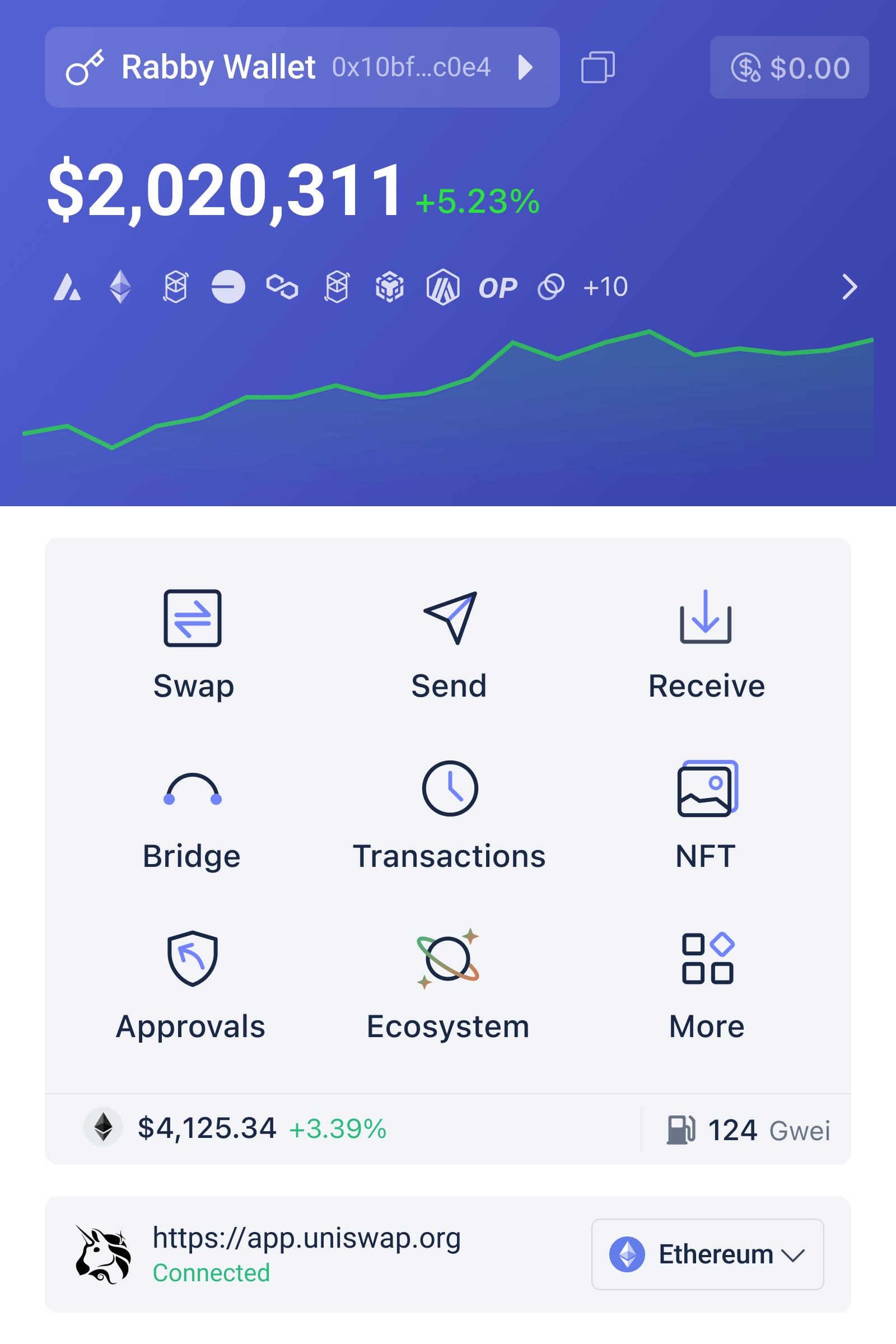
Rabby is an Ethereum-compatible, browser-based cryptocurrency wallet intended for interacting with decentralized applications across supported EVM networks. The browser extension places signing authority close to the application: a user can connect to a trading venue, lending market, bridge, or NFT platform and review requests before approving them. This convenience is useful, but it also creates the central trade-off of self-custody. The wallet can help interpret a request; the user still controls the keys and remains responsible for the final signature.
One common myth is that a wallet “sets” gas prices. In reality, the wallet generally presents network conditions and transaction parameters, while the underlying network determines whether and when a transaction is included. On Ethereum, the fee has two economically important components: a base fee associated with network demand and a priority fee, often called a tip, offered to the validator. The transaction’s gas limit is a ceiling on the computational work it may consume; it is not automatically the amount that will be spent. A transaction that uses less gas than its limit does not necessarily cost the full limit, although setting the limit too low can cause failure.
This distinction matters because gas optimization has at least three different meanings. It may mean paying a lower price per unit of computation, reducing the amount of computation required, or avoiding a transaction altogether. These are not interchangeable. Waiting for a less congested period may reduce the effective fee on a busy network. Choosing a protocol route with fewer contract calls may reduce gas used. Declining a redundant approval can reduce total transaction count. A wallet extension can support the first two decisions through clearer information, but the most powerful optimization is often behavioral: do not sign a transaction whose benefit is smaller than its cost and risk.
How Rabby can improve the signing decision
The useful role of a wallet such as Rabby is best understood as an inspection layer between a DeFi application and the user. Before signing, the user should be able to identify the network, destination contract, assets involved, requested permissions, and expected balance changes. Transaction simulation and warning features, where available and supported by the application and network, can make this review more intelligible than a raw block of contract data. They may reveal that a swap produces an unexpected token, that an approval grants broad spending authority, or that a call is likely to revert.
Simulation is not the same as certainty. A simulated transaction is an estimate based on a particular state of the blockchain. Prices can move, liquidity can change, another transaction can alter state first, and a malicious or malfunctioning contract can behave differently from what a user expects. A warning system can also produce false positives or fail to detect a novel attack. The correct interpretation is not “the wallet guarantees safety,” but “the wallet gives the user more evidence before an irreversible action.” That is a meaningful improvement, especially for users who would otherwise sign from a single opaque prompt.
Readers planning to install the Rabby browser extension should begin with source verification rather than a search advertisement or an unsolicited message. Use the project’s recognized distribution path, check the browser’s extension publisher information, and treat requests for a recovery phrase or private key as disqualifying. For a direct installation starting point, readers can use here. After installation, a cautious workflow is to create or import a wallet only in the extension itself, confirm the correct network, connect to a known application, and test with a small amount before moving meaningful funds.
The recovery phrase deserves special emphasis. A browser wallet is an interface and a key-management environment; it is not a bank account with an account-recovery department. Anyone who obtains the recovery phrase may be able to control the assets, regardless of whether the extension appears locked. Storing that phrase in a cloud note, screenshot, email draft, or password manager with unsuitable security assumptions creates a different risk profile from keeping it offline. Hardware-wallet use can reduce exposure of signing keys, although it does not eliminate phishing, malicious approvals, or the possibility of signing a harmful transaction.
Gas optimization in a real DeFi sequence
Return to the lending example. The user first selects a network. This choice can dominate the economics. Ethereum mainnet may offer deep liquidity and broad protocol availability but can be expensive during periods of demand. Layer-2 networks may lower transaction costs by processing activity away from Ethereum’s base layer and settling related data or proofs through a different mechanism. Their costs, liquidity, bridge requirements, withdrawal paths, and application support differ. A lower displayed gas fee is not sufficient evidence that a network is the better choice if the user must pay a costly bridge transaction or accepts materially worse execution.
Next comes token approval. An approval allows a smart contract to spend a specified token amount on behalf of the wallet. The common assumption that every DeFi action is one transaction is therefore wrong: approval and deposit can be separate calls. Some protocols support permit-style signatures or other designs that reduce a separate on-chain approval, but support is application-specific. A user should not revoke every approval reflexively, either. Revocation itself costs gas, and removing an approval is valuable primarily when the permission is unnecessary, overly broad, or associated with a contract the user no longer trusts.
The swap or deposit then introduces execution risk. A transaction may fail because the quoted price moves beyond the allowed slippage, because the deadline expires, because a contract condition is unmet, or because the gas limit is insufficient. A failed transaction can still consume gas: validators or sequencers performed computation even though the intended state change did not complete. This is why reviewing simulation results, quoted minimum output, deadline settings, and network selection is part of gas optimization, not merely a security ritual.
There is also a less visible cost: opportunity cost. A user who waits for a lower fee may save on gas but lose a favorable market price, an incentive window, or a lending opportunity. Conversely, rushing because a yield appears attractive can turn a modest fee into a large loss if the position is small. A useful heuristic is to compare the expected economic benefit of the action with three costs: transaction fees, execution uncertainty, and smart-contract risk. The wallet can help display some of these factors, but it cannot decide whether the position is worthwhile.
Myths that deserve correction
Myth: the cheapest gas setting is always optimal
Reality: a fee that is too low can delay inclusion, and a transaction with a short deadline may fail while waiting. On some networks, fee estimation is more complex than a single “low, medium, or high” choice. The sensible setting depends on urgency, network conditions, and the transaction’s tolerance for delay. For a routine transfer, patience may be reasonable. For a time-sensitive arbitrage or liquidation-related action, delay may be more expensive than the fee.
Myth: a lower-cost network is automatically safer or better
Reality: network cost is only one variable. Users should also consider whether the application is deployed on that network, whether liquidity is sufficient, whether the bridge is trusted, and whether assets have the expected canonical representation. A token with the same ticker may be issued by a different contract on another chain. Wallet network support improves navigation, but users must still verify addresses and token contracts.
Myth: transaction simulation proves that a contract is safe
Reality: simulation can clarify a likely outcome under current conditions, but it does not constitute an audit or a guarantee. It cannot make an unaudited protocol trustworthy, and it may not capture every future state transition. The boundary condition is especially important during volatile markets, where a transaction can become economically poor between simulation and inclusion.
A practical installation and signing framework
After installing the extension, separate setup from deployment of capital. First confirm that the browser extension is the expected one and that the recovery process is understood. Then connect to a familiar application without immediately funding the wallet. Examine the network and permissions requested. For a first transaction, use a small amount, review the recipient and contract, and check whether the projected balance change makes sense. If the extension presents a warning, investigate it rather than treating it as an inconvenience.
For repeat DeFi users, the most reusable framework is “network, permission, execution, exit.” Network asks where the transaction will occur and what bridging assumptions are involved. Permission asks what a contract may spend and for how much. Execution asks what output, slippage, deadline, and gas conditions apply. Exit asks whether the user can withdraw, revoke, or unwind the position at a reasonable cost. This framework catches mistakes that a narrow focus on the gas number misses.
Looking ahead, the practical value of wallet software will likely depend less on promising to make every transaction cheap and more on improving transaction interpretation. If wallets can present clearer simulations, distinguish harmless technical complexity from dangerous permissions, and compare total execution costs across networks, users may make fewer costly mistakes. That outcome is conditional: it depends on accurate data, compatible applications, and users who read the warnings. The unresolved issue is how much confidence should be placed in automated interpretation when DeFi contracts and market conditions change rapidly.
Frequently asked questions
Is Rabby Wallet a gas-free way to use DeFi?
No. Rabby does not remove network fees. It may help users estimate fees, inspect transaction effects, and choose more informed settings, but the network still charges for computation and inclusion. Users should also account for approvals, bridging, failed transactions, and the cost of moving funds between networks.
Can Rabby prevent every malicious transaction?
No wallet can guarantee that. Warnings and simulations can improve visibility, but they are limited by available data, changing blockchain state, and the design of the application. Users should verify the website, contract, permissions, network, and expected asset movement before signing.
What is the simplest gas-saving habit for a new user?
Before confirming, ask whether the transaction is necessary, whether an approval is already sufficient, and whether the chosen network has the required liquidity and application support. Avoiding a failed or redundant transaction is often more reliable than trying to predict the exact cheapest moment to submit it.
Rabby Wallet is therefore best viewed not as a magic gas optimizer, but as a decision tool for a complicated transaction environment. Its strongest contribution is helping users see more of what they are about to sign. The final advantage still comes from disciplined choices: verify the source, protect the recovery phrase, understand permissions, compare total costs, and treat every simulation as evidence rather than a promise.
